When the Lab Splits: Protecting Your Conference Plans After a PI Departs
The Abstract Was Accepted. Then the Advisor Resigned.
Every spring, thousands of American graduate students hit 'submit' on conference abstracts that list a principal investigator as the final author. The assumption baked into that workflow is stability: the lab will still exist in October when the meeting rolls around.
Sometimes it doesn't. A tenure dispute, a poaching offer from a rival institution, a health crisis, or a failed renewal at an R1 can send a PI across the country mid-semester. What follows is rarely a clean handoff. Grant accounts freeze, lab access revokes, and — less visibly — a season of conference planning goes up for renegotiation.
Unlike journals, most scientific meetings have no formal process for adjudicating who owns a presentation when a collaboration ends. That silence leaves students exposed.
Who Presents the Work?
The prevailing norm in US academia is that the person who did the work presents it. Program committees generally care that the research is legitimate and that the listed presenters are qualified — not which department's payroll they sit on.
In practice, though, leverage matters more than norms. A departing PI may want the talk delivered at their new institution to signal continuity; the home department may want the work presented locally to justify remaining lab resources. Students caught between the two often discover that whoever controls the travel money controls the podium.
Graduate students should know that most conference policies allow a change in presenting author with a simple email to the program chair. If the original presenter is the student — and they should be — the presentation typically travels with them, not with the advisor.
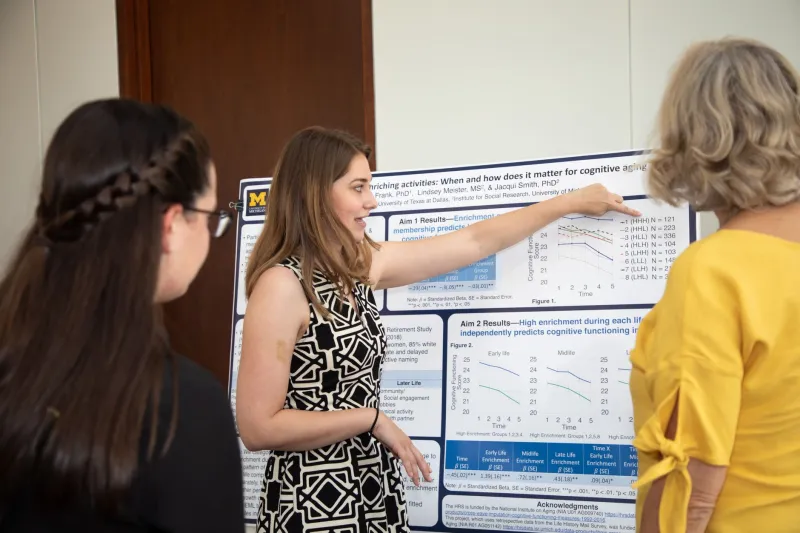
The Poster Belongs to Whoever Made It
Physical artifacts are simpler than credit. A poster printed with a student's university logo and their own design work is, for practical purposes, theirs. The underlying data is a different question: if the experiments were funded by the PI's grant, the PI's institution usually retains rights to the data itself, even after the PI leaves.
This creates an awkward asymmetry. A student may be entitled to present the work while the data it rests on lives on a server they can no longer access. Smart students resolve this before departure day — exporting datasets, notebooks, and analysis files they generated, and confirming with the research office what they may legitimately take.
Authorship Is Negotiated, Not Inherited
Co-author lists on a conference abstract are not fixed at submission. Most meetings permit revisions until the program locks, and some allow corrections afterward. When a lab splits, students should document their contributions in writing and raise authorship questions early, ideally with a neutral party such as a department ombudsperson.
The ICMJE criteria — substantial contribution, drafting, approval, accountability — remain the reference standard at US institutions, and citing them in a difficult conversation gives students something firmer than feelings to stand on.
Five Moves to Make Before the Lab Dissolves
- Export everything you generated. Data files, analysis code, figure source files, and drafts. Do this while you still have credentials.
- Contact the conference directly. Program chairs handle these situations more often than you'd think, and most will accommodate a presenting-author change or a withdrawal-without-penalty.
- Ask about the travel award in writing. Some society grants are tied to the PI's membership or institution. Get the terms in an email, not a hallway conversation.
- Identify a local co-sponsor. A co-author or committee member at your current institution can lend institutional cover to your registration and travel requests.
- Document your contribution now. A dated summary of what you did — experiments, analysis, writing — is invaluable if authorship is later disputed.
The Department's Role
US universities are slowly developing policies for 'orphaned' trainees, but conference logistics rarely appear in them. Graduate program directors, however, often have discretionary funds that can replace a vanished PI travel account, particularly for students presenting accepted work. The ask is easier when it's framed as protecting the university's own research visibility — an accepted abstract is a line on the department's annual report.
A Structural Problem, Not a Personal One
The deeper issue is that conference systems assume permanence that American academic careers don't offer. Abstract portals have no field for 'PI departed mid-cycle.' Travel grants rarely include contingency language. Students navigating a lab breakup are improvising without institutional support.
Until that changes, the best protection is unglamorous: keep copies, ask questions in writing, and remember that the work you did — and the right to stand behind it at a podium — belongs to you, wherever your advisor's office ends up.