Empty Slide, Full Consequences: What Really Happens When a Researcher Withdraws an Accepted Talk
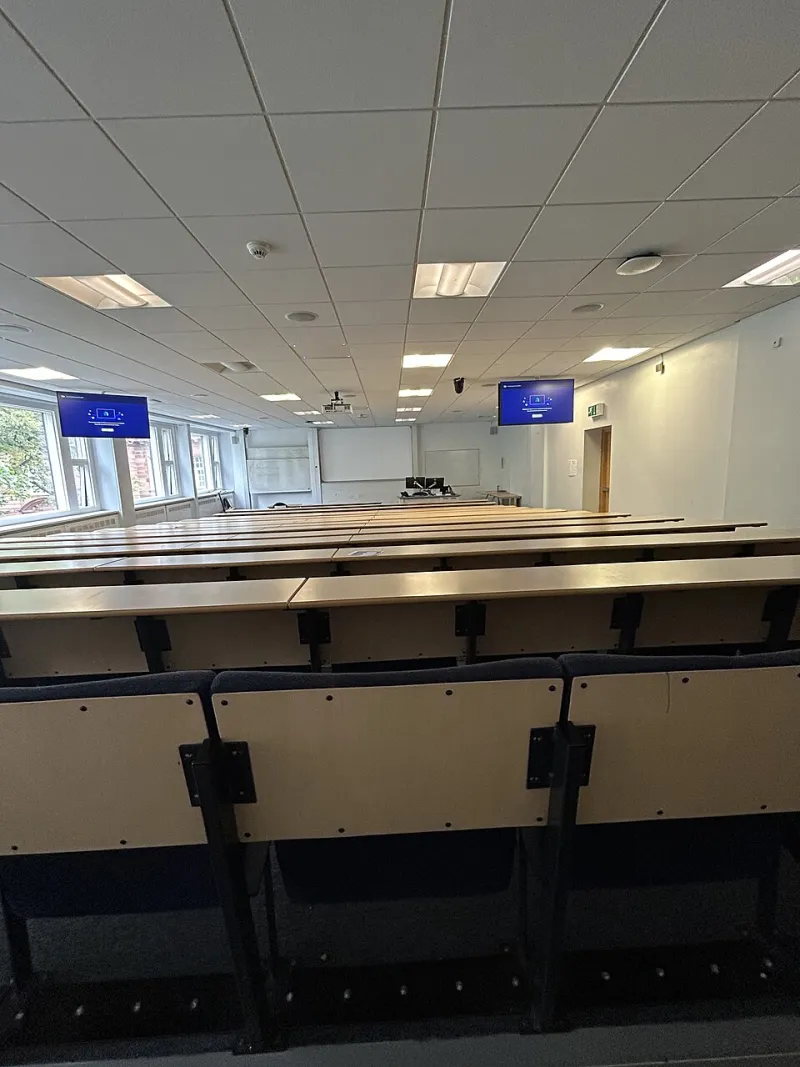
Photo: Sahaib, CC BY 4.0, via Wikimedia Commons
The acceptance email arrives in February. The withdrawal email goes out in June. In between, something has broken — a grant did not come through, a visa appointment never materialized, a co-author found an error in the dataset. What follows is one of academic life's least discussed rituals: pulling an accepted conference talk.
Program committees in the United States plan around accepted submissions. Session slots, poster board assignments, and printed programs are all built on the assumption that the names in the abstract will appear in the room. When they don't, the withdrawal is logged, the slot is patched, and — in most cases — nothing is said publicly. That silence has allowed a set of assumptions to harden about what a withdrawal signals and who it hurts.
The Reasons Behind the Retreat
Withdrawals rarely stem from a single cause. Interviews with researchers across several disciplines point to a familiar cluster of pressures.
Visa and travel barriers remain the most common driver for international researchers presenting at US meetings. A delayed visa interview or a denied application can erase months of preparation regardless of the quality of the work. Domestic researchers face a parallel problem: institutional travel funds that were promised in the fall sometimes evaporate by spring, leaving a graduate student or postdoc with an accepted talk and no way to get to the meeting.
Cooling data is a quieter but persistent factor. A researcher who submitted an abstract in October may, by June, realize the preliminary result no longer survives additional controls. Presenting work that has since weakened is a risk many are unwilling to take, particularly in fields where preprints and conference abstracts are indexed and cited.
Personal circumstances — a family emergency, a medical issue, the collapse of a lab arrangement — round out the list. These are the withdrawals least likely to be explained, because the researcher often has no obligation to explain at all.
How Committees Actually Treat Withdrawals
The fear driving many researchers to simply not show up rather than formally withdraw is the belief that a withdrawal becomes a permanent mark. Program committee members interviewed for this piece describe a more mundane reality.
Most committees distinguish sharply between a withdrawal before the program is finalized and a no-show after. The former is routine; the latter — when a presenter silently fails to appear — is what actually irritates organizers, because it wastes a session slot and disrupts session chairs. A timely, clearly stated withdrawal is, in the eyes of most organizers, the professionally responsible act.
That said, context matters. Repeated withdrawals from the same researcher across multiple meetings can raise questions at small, tightly networked conferences where organizers compare notes. A single withdrawal, communicated promptly, generally does not.
The Career Question
For early-career researchers, the calculus is more personal. A conference presentation is often a line on a CV that signals productivity, particularly for graduate students who may not yet have first-author publications. Withdrawing removes that line.
Yet the alternatives can be worse. Presenting data that no longer hold up invites scrutiny the researcher is not prepared for. Attending without funding can mean thousands of dollars in unreimbursed expenses — a burden that falls hardest on those with the least financial cushion. And a missed visa appointment is, in any case, beyond the researcher's control.
The more consequential risk is informal: the colleague who noticed the name missing from the program, the potential collaborator who had hoped to catch the talk. These losses are real but diffuse, and they are largely recoverable by presenting the same work at a subsequent meeting.
Best Practices for a Clean Withdrawal
Researchers who have navigated a withdrawal successfully tend to follow a similar playbook:
- Notify the program chair as early as possible, ideally before the final program is compiled, so the slot can be reassigned.
- Provide a brief, honest reason without over-disclosing. "Due to unforeseen funding circumstances" or "a personal matter requiring my absence" is sufficient.
- Ask whether remote presentation or a co-author substitution is possible. Many US meetings now accommodate both, preserving the abstract's place in the program.
- Keep the acceptance and withdrawal correspondence. If a funder or employer later asks why a listed presentation did not occur, documentation helps.
- Resubmit the work. A withdrawn abstract is not a dead abstract; most meetings have no rule against submitting revised versions of the same work the following cycle.
A Normal Part of the Job
The stigma around withdrawal reflects a broader discomfort in American academic culture with visible fallibility. Conferences present an image of seamless execution, and withdrawals puncture that image. But the underlying causes — fragile funding, immigration bottlenecks, the ordinary messiness of research — are structural, not personal.
A withdrawn talk, handled transparently and followed by a resubmission, is a footnote rather than a stain. The researchers who suffer genuine damage are usually those who disappear silently, leaving a gap in the program and questions in the room. The withdrawal email is not the career risk. The no-show is.