Five Seconds of Plastic: How Conference Badges Sort Us Before We Say a Word
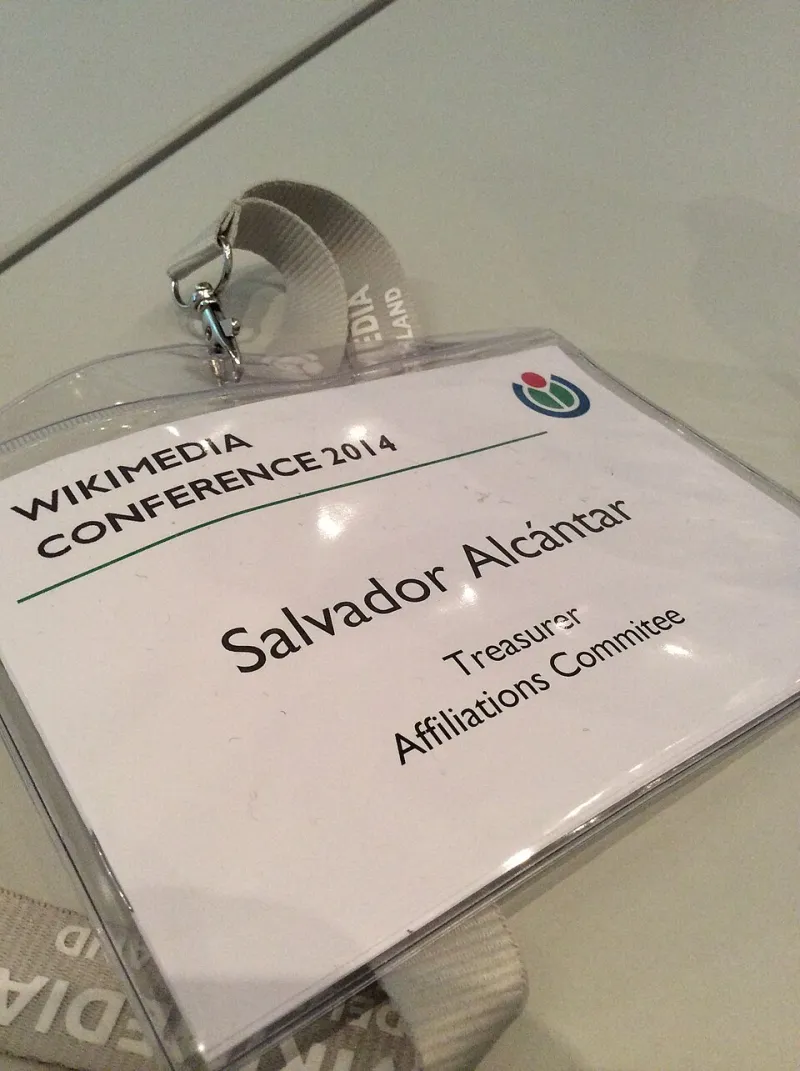
Photo: salvador_alc, CC BY-SA 3.0, via Wikimedia Commons
Walk into the registration hall of any major American science meeting — the Moscone Center, the Boston Convention Center, a hotel ballroom in Atlanta — and you will receive a small piece of laminated plastic that does more work than your entire poster. Within five seconds of any interaction, other attendees have read it, parsed it, and quietly filed you into a mental hierarchy. The badge speaks first. Often, it speaks loudest.
This is the name badge economy: an unspoken system of status signaling that operates at every scale, from the Society for Neuroscience annual meeting's 20,000-plus attendees down to a regional ecology symposium of 200 people. And for early-career scientists, understanding it is not vanity. It is strategy.
The Anatomy of a First Impression
Consider what a badge actually communicates before a handshake. The institution name is the headline — a Harvard, Stanford, or NIH affiliation triggers an instant recalibration of attention. The session title beneath your name tells a reader whether you are a keynote, an invited speaker, a contributed talk, or, most tellingly, a poster presenter. Some meetings add ribbon layers: "Speaker," "Press," "Board Member," "Exhibitor." Each strip of colored ribbon is a rank insignia.
The result is a sorting mechanism nobody designed and everybody enforces. A first-time presenter at a large meeting described the experience bluntly: "I watched people's eyes drop to my badge, see 'Graduate Student' and a state school, and then watch the conversation momentum just evaporate. It happened enough times that I started covering the bottom half of my badge with my coffee cup."
Seasoned speakers notice it too, often with discomfort. A full professor who has attended American Geophysical Union meetings for two decades put it this way: "The badge is a shortcut, and shortcuts are usually wrong. But admitting that doesn't stop me from taking it."
Why the Badge Persists
Defenders of badge conventions point out that at scale, some filtering is unavoidable. You cannot meet everyone at a mega-meeting. Badges are a heuristic, and heuristics save cognitive bandwidth. The problem is not that attendees read badges — it is what they read into them.
Research on thin-slice judgments suggests people form durable impressions of competence within seconds, well before any evidence arrives. Layer that onto a badge that displays career stage, institutional prestige, and session type, and you have a system that systematically channels attention and opportunity toward those who already have it. The junior person from a less-famous institution gets less eye contact, shorter conversations, fewer hallway invitations.
Working the System Without Being Worked by It
The good news, drawn from conversations with presenters who have navigated this terrain successfully, is that the badge economy has exploitable loopholes.
Lead with the work, not the affiliation. Attendees who open conversations with a specific finding, dataset, or provocative question consistently report outperforming their badges. The badge sorts you until you speak; then the sorting has to compete with your actual ideas.
Choose rooms where badges matter less. Small workshops, lightning-talk sessions, and evening mixers flatten hierarchies. A 15-person roundtable at a large meeting gives a graduate student more genuine contact with senior scientists than three days in the poster hall.
Volunteer strategically. Session-room aides and student volunteers wear their own ribbons, but the role grants legitimate, purposeful access to speakers and organizers. You are no longer someone hoping to be noticed; you are someone with a task, which is a far better conversation opener.
Reframe the poster label. Some meetings let presenters customize how their session appears or add social handles. Where possible, fill that space with something that invites a question rather than a judgment.
What Organizers Could Do
There is also a structural fix worth naming. A growing number of meetings have experimented with double-blind poster judging, minimized ribbon hierarchies, or badges that de-emphasize career stage. The evidence that these changes improve reviewer fairness is still accumulating, but the direction is clear: if badges shape who gets attention, then badge design is an equity lever, not a logistical afterthought.
Program committees that want a broader pool of voices should ask what their credentials communicate. A meeting that celebrates interdisciplinary work but prints rigid status markers on every lanyard is sending mixed signals.
Read the Room, Then Read the Badge
None of this means early-career scientists should approach conferences as status combat. It means recognizing that the pecking order exists, that it operates in seconds, and that it is neither permanent nor accurate. The badge tells people who you were when you registered. What you say in the next four minutes tells them who you are becoming.
The plastic is on the table. The ribbon is pinned. Now open your mouth — and out-talk your lanyard.