Poster Hall to Podium: Mapping a Five-Year Conference Strategy for Early-Career Scientists
Every tenured professor once stood nervously beside a poster board. What separates those who eventually deliver keynotes from those who plateau is rarely talent alone — it is strategy. For graduate students and postdocs in the United States, building a deliberate conference trajectory can compress a decade of academic visibility into five focused years.
Year One: Start Regional, Start Small
The instinct to chase the biggest meeting on the calendar — Experimental Biology, Neuroscience, AGU — is understandable but often premature. Regional meetings such as those hosted by state-level ACS sections or the annual symposia of regional NIH IDeA networks offer lower stakes, shorter abstract deadlines, and dense access to local faculty who may later sit on your thesis or hiring committees.
A first poster at a regional meeting accomplishes three things: it forces you to condense your project, it gives you practice fielding questions, and it produces a line for your CV without requiring preliminary results that can survive national scrutiny.
Years Two and Three: Go National With Purpose
By mid-degree, the calculus shifts. National meetings matter not only for exposure but for the people in the audience. When selecting among the major societies, weigh three factors:
- Speaker overlap. Scan the program for investigators whose work you cite. A national meeting where three of your target collaborators present is worth more than a larger meeting where none do.
- Session fit. Generic submissions to broad themes compete against hundreds; a well-matched themed session or mini-symposium dramatically improves acceptance odds and audience quality.
- Timing against milestones. Aim to present your strongest dataset nationally in the six to twelve months before you go on the job market, not after.
Abstract deadlines for major US meetings cluster in predictable windows — October through February for spring and summer conferences. Build your submission calendar around your dissertation timeline rather than scrambling when deadlines arrive.
Converting Presentations Into Collaborations
A talk or poster is an advertisement; the follow-up is the sale. The most effective pattern we observed among successful early-career scientists is the 48-hour rule: within two days of a meeting, send short, specific emails to everyone who asked a substantive question. Reference their comment directly. Generic follow-ups get ignored; specific ones get answered.
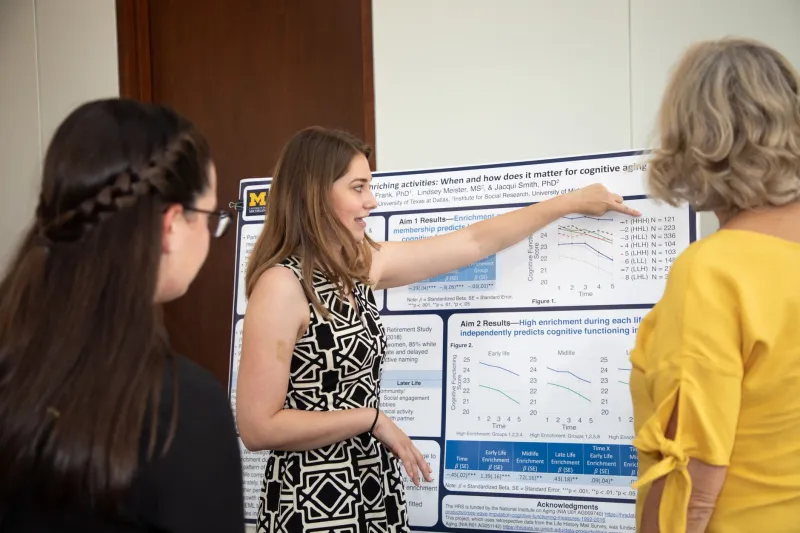
Poster sessions, in particular, are underused networking infrastructure. Arrive early to your session, wander before your slot, and attend sessions adjacent to your field. A collaboration between a computational biologist and an experimentalist frequently begins with two people standing awkwardly in the same poster aisle.
How PIs Actually Spot Promise
We asked several principal investigators at US research universities what draws their attention in a poster hall. Their answers were remarkably consistent — and instructive.
"I don't read the poster first," says one immunology lab head in the Midwest. "I watch how the presenter handles a hard question. Deflection tells me one thing; a clear 'we don't know yet, but here's the experiment' tells me something better."
Another, a materials scientist, emphasizes clarity over volume: "The students who can explain their control conditions in two sentences are the ones I remember. The ones who recite every panel are not."
A recurring theme: PIs are auditing thinking, not data. A modest dataset defended with rigor outperforms an impressive dataset delivered defensively.
Years Four and Five: From Submitted Talks to Invited Ones
The final stretch of the roadmap is about reputation compounding. Present the same line of work across two or three national meetings so that your name becomes associated with a question, not just a paper. Volunteer for society activities — session moderation, student award judging, early-career committees — because organizers invite speakers they already know.
By the time you are a postdoc or new assistant professor, your goal inverts: instead of applying for platform sessions, you respond to invitations. That happens when organizers can find you — a current meeting profile, an ORCID-linked talk history, and a personal page listing your presentation topics all shorten that search.
The Long Game
Five years sounds long, but in conference time it is roughly ten abstract deadlines and a dozen name badges. Treated deliberately, that span takes a scientist from an anxious first poster to a podium invitation — and the relationships built along the way will outlast every badge lanyard.