The Abstract That Sounds Like Everyone: AI Disclosure and the New Submission Etiquette
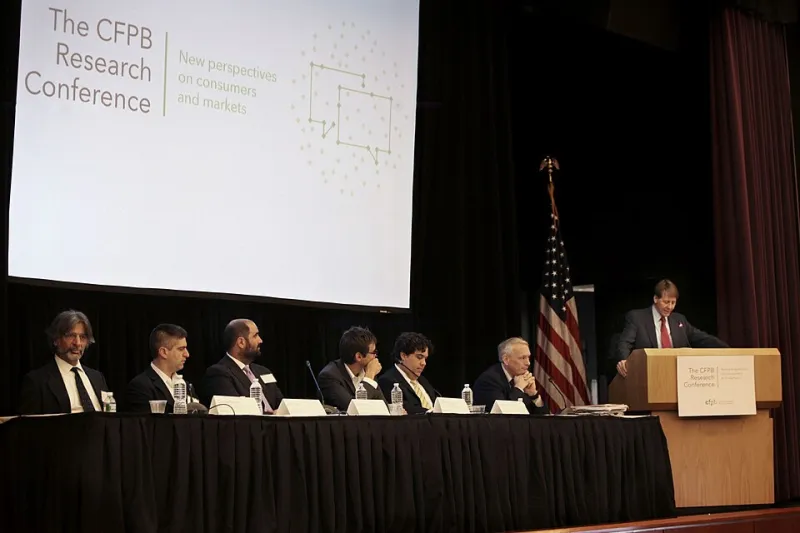
Photo: Consumer Financial Protection Bureau from United States, Public domain, via Wikimedia Commons
A Quiet Change in the Submission Form
Open almost any 2026 call for papers from a US scientific society and the familiar fields are still there: title, authors, affiliation, abstract body, and keyword selection. But somewhere near the attestation box, a newer question has appeared. It may ask whether generative AI was used in preparing the submission. It may ask for a short disclosure. It may simply require the submitting author to confirm that the intellectual content is their own and that any assistance has been acknowledged.
The language varies, but the direction is consistent. Meetings are no longer treating AI as an exotic edge case. They are treating it as a normal part of the writing environment that nonetheless requires a paper trail. That shift matters most for early-career researchers, who are often the ones drafting abstracts under deadline pressure and the ones least likely to have seen a society's updated submission policy in full.
What Meetings Are Actually Asking
Most current policies do not attempt to prohibit AI use outright. Instead, they draw distinctions that are easy to miss in a crowded CFP. Grammar and language editing is usually treated differently from generating substantive scientific claims. Formatting help is treated differently from drafting an entire abstract. The common thread is authorship responsibility: a human author must be able to defend the content, verify the references, and answer questions at the podium.
Several US meetings now ask authors to avoid uploading confidential or unpublished data into external tools. Others remind reviewers that submissions are confidential and should not be pasted into public chatbots. Some program committees have added disclosure checkboxes; fewer have announced formal AI-detection screening, and those that have done so tend to describe it as one signal among many rather than a decisive test.
That is an important nuance. Detection tools remain unreliable, particularly for short technical prose written by competent humans and lightly edited by machines. A false positive can damage trust, but a false negative does not make an abstract ethical. The policy is ultimately about disclosure and ownership, not about whether a classifier assigns a probability score.
Where the Risk Really Sits
For graduate students, the greatest risk is not an accusation of cheating. It is a submission that loses the specificity that makes an abstract reviewable. AI-assisted drafts often smooth away the rough edges that signal a real research problem: the exact sample size, the awkward limitation, the unexpected null result, the reason this method was chosen over another. Reviewers notice when an abstract reads like a template with a topic inserted.
For postdocs, the risk is often confidentiality. A manuscript in preparation, a grant idea, or preliminary data may be exactly the material a researcher is tempted to summarize with a tool. Many US societies now explicitly warn against entering unpublished data into services that may retain or train on inputs. The safer practice is to use AI on structure and language after the scientific content has been written, not to use it as a first reader for confidential material.
A third risk is inconsistency. If an abstract is heavily machine-drafted, the presenting author may struggle to answer questions in the session. Program chairs sometimes notice a mismatch between a polished submission and a hesitant talk. That mismatch does not prove misconduct, but it can affect how the presentation is received.
A Practical Protocol for 2026
A defensible workflow is not complicated. Write the scientific core first: the question, the method, the result, and the interpretation. Keep a draft history. Use AI, if at all, for compression, grammar, or checking whether the abstract follows the CFP's required structure. Verify every citation and every number manually. Disclose assistance according to the meeting's instructions, even when the instructions are vague. And ask a mentor or labmate to read the final version for voice and specificity.
The disclosure itself should be brief and factual. A sentence noting that generative AI was used for language editing, with all scientific content reviewed and approved by the authors, is usually sufficient where disclosure is requested. What meetings do not want is a vague attestation that leaves the reader unsure whether the author can stand behind the work.
The Reviewer's View
Reviewers are reading under time pressure. They are looking for a clear problem, a credible method, a result that matters, and an author who knows the material. AI assistance does not automatically undermine any of those things. It becomes a red flag when the abstract is long on framing and short on evidence, when references look plausible but do not check out, or when the prose has a uniform fluency that obscures the actual contribution.
The most durable advice for 2026 is therefore unglamorous: use the tool as a tool, keep the scientific judgment human, and make the submission sound like the person who will present it. The ghost in the call for papers is not the machine itself. It is the absence of an author who can explain the work.